No, and this one surprises almost everybody. Newton's consolidated property tax rate is 39.53 per $1,000 of taxable value, and Ankeny with Ankeny schools is 36.68, so Newton's rate is actually.

Dated: August 11 2026
Views: 5
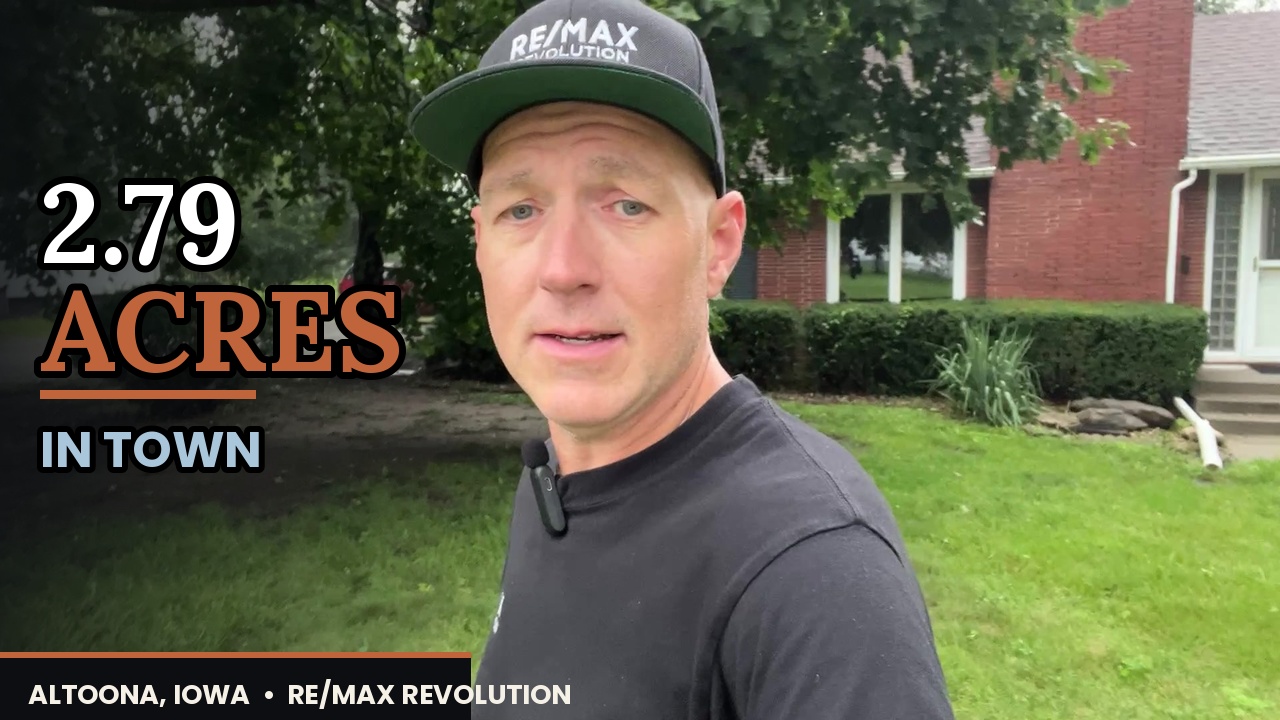
Acreage in the Des Moines metro almost always comes with a trade. You get the trees and the elbow room, and in exchange you drive twenty minutes for a gallon of milk. That is the deal most buyers accept when they start looking outside the city.
This property does not ask you to make that trade.
It sits inside Altoona city limits on 2.79 acres, about five minutes from I-80, with mature oak, maple, mulberry, and walnut spread across the lot. There is an established garden area and a raspberry patch. The back of the property has direct access to the Vern Willey II Trail.
See the full property tour on YouTube
I walked all of it on camera, and I did the part most tours skip. I went into the basement, opened the electrical panel, read the furnace, and walked the foundation out loud.
Here is everything I found, including the parts that would give me pause.
Most of what makes this listing unusual has nothing to do with the house.
The lot runs deep and open behind the home. There is a fully fenced yard closer in, which matters if you have a dog or small kids, and then the property opens up into lawn and mature trees. The trees are the kind you cannot buy. An oak that size represents fifty or sixty years of growth, and no amount of money makes one appear on a new-construction lot.
The trail access is the piece I would not undersell. The Vern Willey II Trail connects into Altoona's broader trail system, and having it at the back of your property means you can walk or bike from your own yard without loading anything into a car. In a metro where trail proximity gets marketed hard, direct access from the parcel is genuinely rare.
For a buyer, the honest question is what you intend to do with the space. Room for a serious shop, you already have, and I will get to that. Room for animals is a zoning conversation you should have with the city before you write anything. Room for a fire pit, a garden, and kids who need somewhere to go is immediate and obvious.
But space is not free, and I want to be direct about the cost.
Gross taxes on this property run $6,802. For a $439,900 listing in the 50009 zip code, that is high. The average for the area sits closer to $3,000. You are paying acreage taxes on an in-town parcel, and it shows up in your escrow every single month. Run the real payment before you get emotionally attached, because a $300 monthly difference in taxes changes what house you can afford more than most buyers expect.
If you are coming from outside the metro, Altoona probably is not the suburb you have heard of. Ankeny and Waukee get most of the attention. That is worth understanding, because it affects both what you pay and what you get.
Altoona sits on the east side of the Des Moines metro in Polk County. It is where Adventureland is, and where the Outlets of Des Moines opened, which means the retail and entertainment base is stronger than the population alone would suggest. Meta built a data center here, and that tax base has been good for the town's infrastructure.
The schools here are Southeast Polk, which is one of the larger districts in the state. That is a meaningful data point for families and worth researching directly rather than taking anyone's word for it, mine included.
The commute picture is the practical advantage. I-80 is about five minutes away, which puts downtown Des Moines at roughly twenty minutes in normal traffic and the eastern job corridor even closer. Compare that to acreage properties in Runnells or Bondurant, where you are adding real drive time for similar land.
What you give up choosing Altoona over the west-side suburbs is newness. The housing stock here skews older. If you want a 2022 build with a smart thermostat and a builder warranty, you are looking in Waukee or Grimes and you are paying for it. If you want mature trees, more land, and a lower entry price, the east side is where that math works.
Three bedrooms, two baths, 1,603 square feet on the main level with a 1,202 square foot basement underneath.
Brick is the first thing I note from the curb, and not for looks. Brick means you are not scraping and repainting siding every seven years. The long-term exterior maintenance cost on a house like this is genuinely lower than the vinyl-sided new construction you will tour fifteen minutes west, and nobody puts that in a listing description.
Inside, the oak floors have been refinished. Original hardwood under decades of carpet is one of the real advantages of pre-war housing stock, and this seller already did the work of bringing it back.
The windows were updated in 2024 and carry a lifetime warranty. I want to flag how much that matters. Windows are one of the most common five-figure surprises in a house built before the war, and buyers routinely underestimate the cost. Twenty windows at $600 to $900 each adds up fast. This seller already spent that money, and the warranty transfers.
The kitchen has been refreshed with newer Whirlpool appliances. The bathroom has heated tile floors and a walk-in shower. Heated floors are a small luxury that is expensive to retrofit because it means pulling up the existing floor, so getting one already installed is a genuine value.
The basement is listed as partially finished with office or flex space. In a house this size, that lower level effectively doubles your usable square footage if you want it to.
This is the part of the tour where my first career shows up, and it is the reason I make these videos the way I do.
Before real estate, I worked as a telecom technician and an electrical apprentice. That background permanently changed how I walk through a house. Most tours spend eight minutes on countertops and zero seconds on the mechanical room. I do the opposite, because the mechanical room is where your next five years of ownership costs are hiding.
The electrical panel. I open the door and read three things: capacity, brand, and workmanship. A 100-amp panel runs a normal house fine, but if you are planning a hot tub, an EV charger, or a finished basement, you are pricing a service upgrade at two to four thousand dollars. Brand matters too. Federal Pacific and Zinsco panels have documented failure-to-trip histories and insurers increasingly balk at them. And workmanship tells you a story: double tapped breakers, scorch marks, and mismatched breaker brands tell me whether a licensed electrician has been in that panel or whether a previous owner watched a video and gave it a try.
The wiring era. On a 1939 house I am always asking what the branch wiring looks like. Knob and tube shows up in Des Moines housing stock from this period, and some insurance carriers will not write a policy on it unmitigated. That is not a reason to walk away from a house, but it is absolutely a reason to get an insurance quote before your contingencies expire rather than after.
The foundation. This is a block basement, so I walk the walls looking for two different things that people constantly confuse. Vertical hairline cracks are usually settling and usually fine. Horizontal cracking with visible inward movement is the expensive one, potentially eight to fifteen thousand dollars, and it is the difference between a negotiation and a walk-away. I also look for efflorescence, that white mineral bloom on block, because it tells you moisture has been moving through the wall even if the floor is dry today.
The mechanicals. Serial numbers tell the truth about age even when nobody has written it down. Furnaces run roughly fifteen to twenty-five years, air conditioners twelve to seventeen, water heaters eight to twelve. Here is the part buyers miss: a system can be running perfectly and still be at the end of its life. Those are not contradictory statements. The only question that matters is whose budget replaces it, and if the answer is yours, that belongs in your first-year reserve, not in the maybe pile.
The water path. Outside, I look at grading, because water is the number one enemy of Iowa basements and the story always starts outside the house. Soil should slope away from the foundation, roughly six inches of drop in the first ten feet. Mulch piled against the siding and downspouts dumping right at the foundation are how dry basements become wet ones.
None of this replaces a professional home inspection, and I want to be clear about that. What it does is tell you whether to write the offer at all, and what to write into it. By the time your inspector shows up, you have already committed earnest money and put the house under contract. Knowing what you are walking into beforehand is worth more than finding out later.
If the acreage is the story, the shop is the exclamation point.
Thirty-two feet by forty-five feet, with 200-amp service, 110/220 hookups, and a new premium steel roof. That is not a garden shed with a workbench in the corner. That is a building you can genuinely run equipment in.
The 200-amp service is the number to pay attention to, and it is the kind of detail that gets buried in a listing. Plenty of outbuildings have power run to them as an afterthought, a single circuit good for an overhead light and a battery charger. Two hundred amps with 110/220 hookups means you can run a welder, an air compressor, a lift, or a serious woodshop without rewiring anything first.
The new steel roof matters for a boring but important reason. Outbuilding roofs are a maintenance item that owners defer, and a leaking shop roof ruins whatever is stored under it. This one has been handled.
For the right buyer, this outbuilding is worth more than the third bedroom. If you have a trade, a hobby that involves tools, or equipment that currently lives outside under a tarp, this building changes what the property is worth to you specifically.
I would be doing you a disservice if I only told you the good parts.
You mow it. Two and three-quarter acres is not a push mower situation. Budget for a riding mower and budget for the time. Figure two to three hours every week through an Iowa growing season.
The tax bill is permanent. That $6,802 is not a one-time cost. It is every year, and assessments generally move in one direction.
Older homes are a relationship, not a purchase. A 1939 house will always have a list. Something is always aging out. That is not a defect, it is the nature of the thing, and buyers who understand it going in are happy while buyers who expected a maintenance-free experience are miserable.
Insurance can be particular. Between the age of the house and the outbuilding, get your quote early in the process rather than at the end. Carriers ask questions about older electrical, and you want that answer before your inspection contingency expires.
None of these are reasons not to buy. They are reasons to buy with your eyes open, which is the only way I want any of my clients buying anything.
If I were representing a buyer on this property, this is my short list:
This is not a house for everyone, and I would rather tell you that than waste your Saturday.
It is 1939. The acreage needs mowing. The tax bill is real. If you want turnkey and new, this is the wrong listing and you should be looking at new construction in Grimes or Waukee where your money buys a warranty instead of trees.
It is an excellent house for a specific buyer. Someone who wants genuine space without leaving town. Someone who has a real use for a 32x45 shop with 200-amp service. Someone who understands that an older home on land is a relationship you maintain rather than a product you consume.
If that describes you, watch the full walkthrough at the top of this post. I show every room, the basement, the mechanicals, and the shop, and I say out loud what I would check before writing an offer.
And if it does not describe you, that is useful information too. Knowing what you do not want is how you find what you do.
I put everything I look at before my buyers write an offer into a free guide: What a Trades Guy Checks Before You Offer. The electrical panel, the furnace, the grading, radon, Iowa's abstract closing system, and the contingency mistakes that have cost real buyers fifteen and eighteen thousand dollars.
Get it here: https://jasonhuffey.soldbyrev.com/buyer-guide
See the full listing: 603 1st Street E, Altoona, Iowa 50009 | MLS 739096 https://myre.io/0wFXC1w9AFfu Listed by Ryan Mathews, RE/MAX Revolution
I post a full Des Moines metro property tour every Tuesday. If you are buying in Altoona, Ankeny, Waukee, or anywhere in the metro, I would love to apply to be your realtor.
Jason Huffey, REALTOR® RE/MAX Revolution | Ankeny, Iowa 515-606-1227 | jason@huffeyhomes.com License S73436000

Jason Huffey is a REALTOR® with RE/MAX Revolution serving the Des Moines metro area, including Ankeny, Altoona, Bondurant, Johnston, Polk City, and surrounding communities. As a lifelong Des Moines m....
No, and this one surprises almost everybody. Newton's consolidated property tax rate is 39.53 per $1,000 of taxable value, and Ankeny with Ankeny schools is 36.68, so Newton's rate is actually.
Buying your first home in Newton runs in eight steps, and from accepted offer to keys it usually takes 30 to 45 days. The order matters more than the speed: get clear on your numbers, get pre
If you are getting ready to sell your Des Moines home, the single biggest decision is the price, and here is the honest way to get it right.Pricing right does not mean pricing high. It means pricing
Yes, you want your own representation when you buy in Des Moines, and here is the honest reason. The listing agent works for the seller. If you deal directly with that agent, the person negotiating
 DMAAR: Des Moines Area Association of REALTORS® All information deemed reliable but not guaranteed. All properties are subject to prior sale, change or withdrawal. Neither listing broker(s) or information provider(s) shall be responsible for any typographical errors, misinformation, misprints and shall be held totally harmless. Listing(s) information is provided for consumer's personal, non-commercial use and may not be used for any purpose other than to identify prospective properties consumers
may be interested in purchasing. The data relating to real estate for sale on this website comes in part from the Internet Data Exchange program of the Multiple Listing Service. Real estate listings held by brokerage firms other than REMAX Revolution may be marked with the Internet Data Exchange logo and detailed information about those properties will include the name of the listing broker(s) when required by the MLS. Copyright ©2026 All rights reserved.
Last Updated: September 21, 2026 8:21 PM UTC
Show More...
DMAAR: Des Moines Area Association of REALTORS® All information deemed reliable but not guaranteed. All properties are subject to prior sale, change or withdrawal. Neither listing broker(s) or information provider(s) shall be responsible for any typographical errors, misinformation, misprints and shall be held totally harmless. Listing(s) information is provided for consumer's personal, non-commercial use and may not be used for any purpose other than to identify prospective properties consumers
may be interested in purchasing. The data relating to real estate for sale on this website comes in part from the Internet Data Exchange program of the Multiple Listing Service. Real estate listings held by brokerage firms other than REMAX Revolution may be marked with the Internet Data Exchange logo and detailed information about those properties will include the name of the listing broker(s) when required by the MLS. Copyright ©2026 All rights reserved.
Last Updated: September 21, 2026 8:21 PM UTC
Show More...
